Taxis in Algeria: fuel, strike, fares and ride-hailing
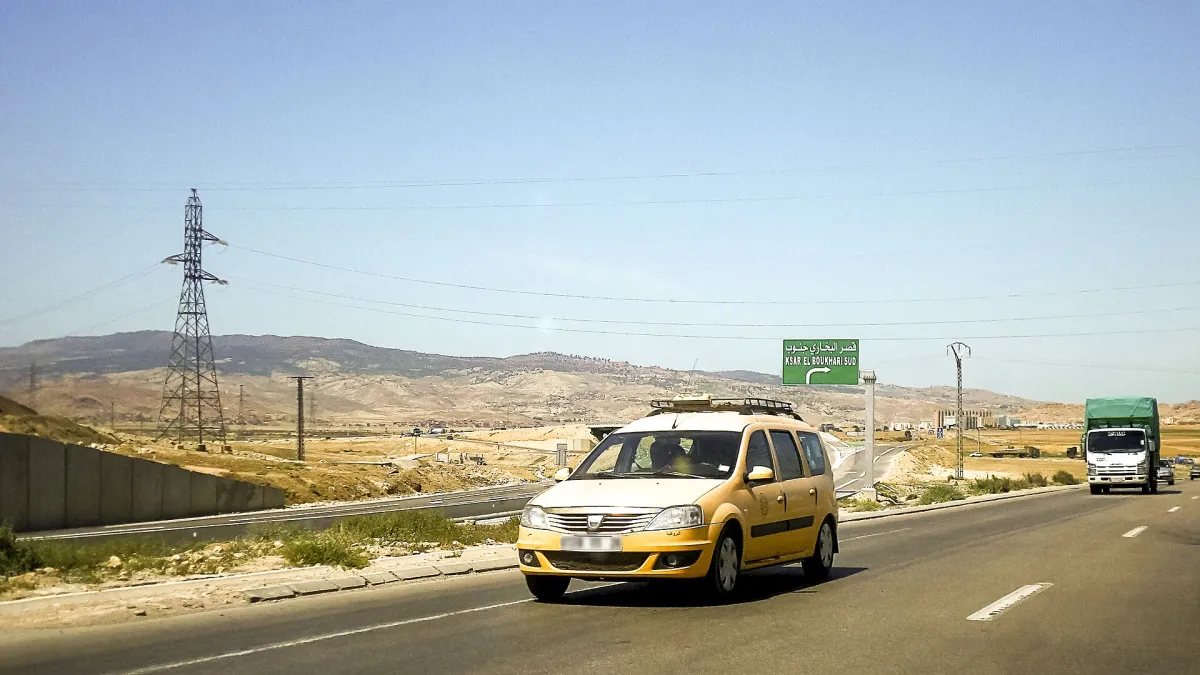
In Algeria, the taxi fills the gaps in public transport: where the bus does not go, after the last train, or between two towns nothing else connects. Since late 2025 the trade has been through a turbulent time: higher fuel prices, a strike, a new highway code and ride-hailing apps. Here is what changed, and what it means for travellers.
Individual taxi, shared taxi
There are two main ways to take a taxi in Algeria. The individual taxi, in town, takes you wherever you want. The shared taxi runs a fixed route, in town or between two towns, and leaves once every seat is taken: each passenger pays for their seat. It is often the only way to reach a small town or a village without a car.
Dearer fuel from 1 January 2026
On 1 January 2026, pump prices went up: petrol rose from 45.62 to 47 DA a litre, diesel from 29.01 to 31 DA, and LPG fuel from 9.20 to 12 DA, a 30% rise for the latter.
| 2025 | 2026 | |
|---|---|---|
| Petrol | 45.62 | 47 |
| Diesel | 29.01 | 31 |
| LPG fuel | 9.2 | 12 |
A strike, then a rise in principle
At the same time, the highway code adopted by the People's National Assembly on 24 December 2025, which toughens penalties, worried transport operators. Taxis and passenger carriers went on strike. On 2 January 2026, the Ministry of the Interior and Transport received their organisations (SNTT, ONTA, UNAT, UGCAA and UGTA). The outcome: an official fare rise was accepted in principle, but the new amounts were not published after the meeting; the ministry said it would take into account the social nature of the service and what users can afford.
The question is not new: as early as 2023, a taxi union reminded TSA that the fare had not moved since 2012.
Ride-hailing, between two statuses
Ride-hailing apps such as Yassir have settled in the big cities, much to the taxis' dismay: in 2023 the same union announced a complaint against Yassir. On 17 December 2025, Minister Saïd Sayoud said the bill regulating these apps was with the General Secretariat of the Government, and that their drivers were not, strictly speaking, operating illegally. Until the text arrives, these services run without a framework of their own.
Practical tips
- Ask the price before you get in, especially for a ride in town: fares vary from one city to another.
- In the evening, when the suburban trains and buses stop, a taxi is often the only option: allow for it in your budget.
For the part of the journey by train, metro or tram, the timetables are also in the free Rekba app, if you would rather have them at hand.
Sources
- Maghreb Émergent — Code de la route, carburant, sanctions : le secteur du transport à l'arrêt
- Algérie Éco — Hausse des prix des carburants : le ministère des Hydrocarbures s'explique
- Algérie360 — Après la grève, les tarifs de transport officiellement revus à la hausse
- Algérie Éco — Le SNTT annonce une hausse des tarifs des transports
- Algérie360 — Grève illimitée des transporteurs : le ministère ouvre le dialogue sur le code de la route
- Algérie Éco — APN : adoption du projet de loi portant code de la route
- Algérie360 — Applications de VTC en Algérie : ce qui va changer en 2026
- TSA — Le syndicat des taxieurs réclame une hausse des tarifs et dépose plainte contre Yassir